Greenpro Africa is following Regenerative Farming Methods because it focuses on the farms soil health which is the most important asset of any farmer. Commercial farming requires massive amounts of water, land, and unless it's an all-organic farm, many types f pesticides are also required.
Crop rotation and the minimum disturbance of the soil to promote soil health, as it also incorporates the use of cover crops, compost teas, compost, and manure (to avoid using synthetic fertilizers), pesticides and genetically modified crops. It is a much cleaner farming method, to confiscate more of the planet's carbo, which Greenpro Africa believes will help to curb global warming.
Greenpro Africa understands that farmlands or the soil is effectively the basis of any farm. Managing the carbon, Water and energy cycles of the farm, and treating the soil organically, with natural products and less human disturbance, are keys to use the soil, with excellent yields and quality.
Below the water, carbon and energy cycles.
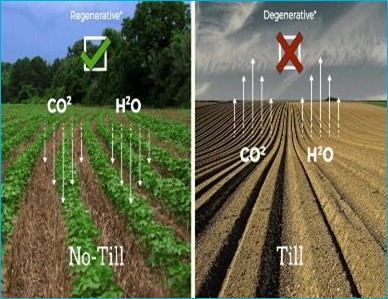
One particularly effective practice from regenerative agriculture is non tilling. Essentially, instead of plowing or using heavy machinery, leaving the soil alone will let it create more organic matter and bind more CO2 than it would with human disturbance.
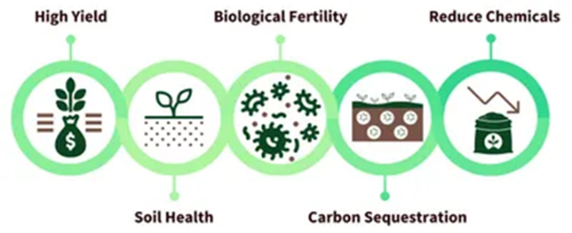
The benefits of regenerative agriculture are basically endless, as it reduces waste, binds CO2 in the soil, and it increases soil fertility organically and restores the critical soil bacteria population. It also improves bio-balance and associated plant resilience in the root zone, serves as a synergist to improve nitrogen fixation, and aggregate soil and prevent erosion.
No-till practice means that the yield is harvested from the land without any tilling of the soil thereafter. The previous plant stems, roots and leaves are left in and on top of the soil to cover the soil from heat and to keep the soil moist for natural soil biodiversity to thrive.
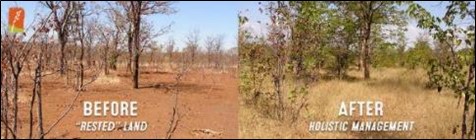
Greenpro Africa experienced the implementation of regenerative agriculture principles to reduce the farmers inputs, especially diesel, while producing better yields than what the farmers would have produced if they used conventional farming practices. The practice is followed by commercial farmers in South Africa with excellent end results. NVIRONMENT - Growing sprouts uses less than 1% of the water and electricity required for standard forage production. Even in times of severe drought you can have fresh green feed. There's no fertilizer used, no pesticides and no soil needed.