
GreenPro Africa’s vision is to empower African farmers through regenerative farming practices, combining engineering expertise with sustainable agriculture to restore soil health, improve yields, and uplift communities.
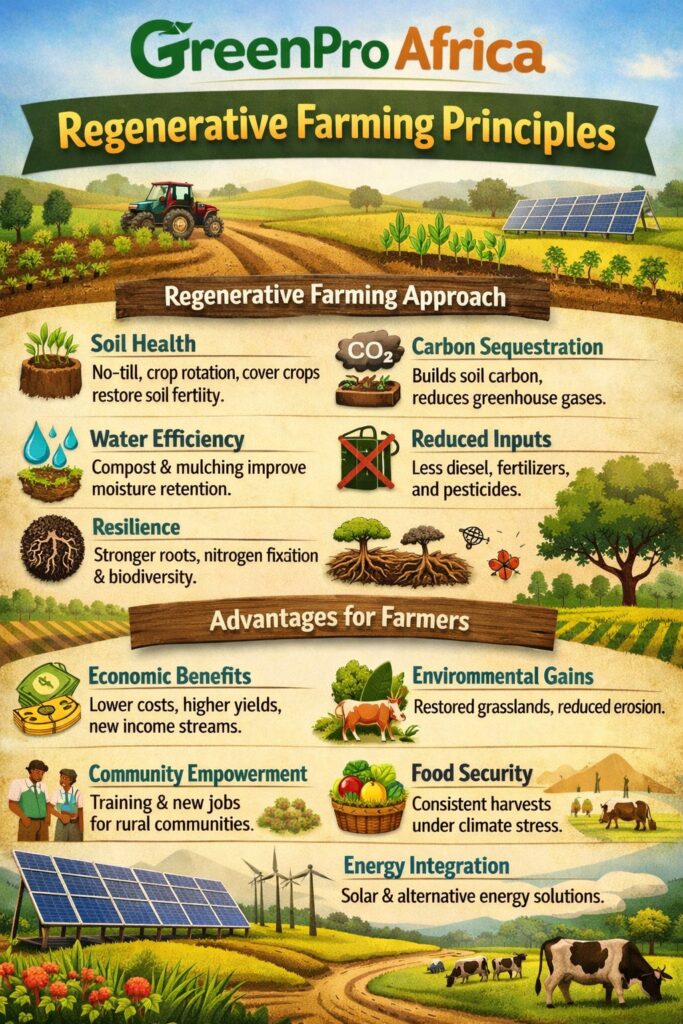
Regenerative Farming Approach
- Soil Health: Practices like no-till farming, crop rotation, and cover crops restore soil fertility.
- Carbon Sequestration: Organic matter builds soil carbon, reducing greenhouse gases.
- Water Efficiency: Compost and mulching improve moisture retention, vital in drought-prone regions.
- Reduced Inputs: Farmers save on diesel, synthetic fertilizers, and pesticides.
- Resilience: Stronger root zones, better nitrogen fixation, and improved biodiversity.
Advantages for Farmers
- Economic Benefits: Lower costs, higher yields, and new income streams from algae, seaweed, and fodder systems.
- Environmental Gains: Restored grasslands, reduced erosion, and healthier ecosystems.
- Community Empowerment: Training rural farmers builds local capacity and creates new jobs.
- Food Security: Sustainable practices ensure consistent harvests even under climate stress.
- Energy Integration: Solar and alternative energy solutions reduce reliance on unstable grids.
Comparison: Conventional vs. Regenerative Farming
| Aspect | Conventional Farming | Regenerative Farming |
| Soil Health | Degraded over time | Restored and enriched |
| Inputs | High fertilizer & diesel costs | Reduced, organic inputs |
| Carbon Impact | Net emissions | Carbon sequestration |
| Water Use | High consumption | Efficient retention |
| Farmer Resilience | Vulnerable to climate shocks | Stronger, adaptive systems |
GreenPro Africa sees carbon credits as a powerful way to turn regenerative farming into direct income for rural farmers, while also tackling climate change. By restoring soils, increasing organic matter, and reducing reliance on fossil-fuel inputs, farmers can generate measurable carbon sequestration that qualifies for carbon markets.