
At GreenPro Africa, we recognize that virgin fields hold immense potential, but they require careful preparation to become productive and sustainable farmland. Our process combines modern technology with proven agronomic practices to ensure long‑term fertility and resilience.
The most important asset for a farmer is the farmland or soil. It must be fertile and constantly monitored accordingly to ensure profitable yields.
Step 1: Soil Assessment
- Comprehensive Testing – analysing soil composition, pH, organic matter, and nutrient levels.
- Mapping and Profiling – identifying variations across the field to guide targeted interventions.
Step 2: Clearing and Conditioning
- Land Clearing – removing vegetation and debris while preserving natural biodiversity where possible. Use mulching equipment to chip the tree trunks and work the chips into the fields as compost.
- Soil Conditioning – applying organic matter, lime, or gypsum to correct imbalances and improve structure.
Step 3: Rehabilitation and Enrichment
- Organic Amendments – incorporating compost, manure, and biofertilizers to build microbial activity.
- Cover Cropping – planting legumes or grasses to fix nitrogen, prevent erosion, and enhance soil health.
- Erosion Control – establishing contour lines, terraces, or windbreaks to protect fragile soils.
Step 4: Precision Preparation
- Levelling and Bed Formation – preparing uniform planting beds for efficient mechanization.
Step 5: Sustainable Integration
- Technology Integration – using sensors and GIS tools to monitor soil health over time.
- Continuous Rehabilitation – maintaining fertility through crop rotation, mulching, and balanced fertilization.
This process ensures virgin fields are transformed into fertile, productive farmland while protecting the environment and supporting long‑term agricultural success.
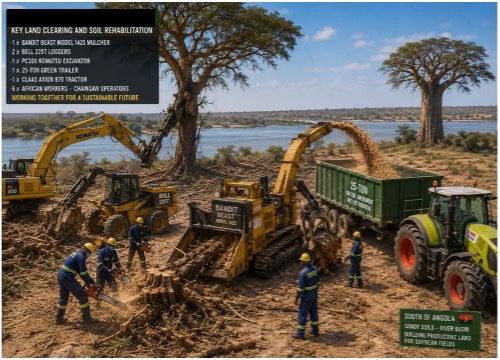
Debushing for new farmland is one of the toughest and most long‑term activities in agricultural development, and here’s why:
- Dense Vegetation Removal – Virgin land in Africa is often covered with thick bush, big trees, and shrubs. Clearing this requires heavy machinery, skilled labour, and significant time.
- Soil Disturbance Management – Removing deep‑rooted vegetation can disrupt soil structure, requiring rehabilitation to restore fertility and prevent erosion.
- Environmental Considerations – Debushing must be done carefully to avoid damaging ecosystems, water sources, or biodiversity. This adds complexity and requires long‑term planning.
Because of these challenges, debushing is not a one‑time task but a long‑term commitment. It requires expertise, planning, and consistent investment to transform virgin land into productive farmland while ensuring sustainability